

This is Better Know a Conference, Buzzer’s annual preview series. Between now and Nov. 2, we’ll be writing the detailed stories — a mix of roster breakdowns and overarching narratives, divided into silly tiers — of the 2026-27 season to come.
This year, we’re also running our first ever subscriber sale, where you can get 25% off an annual subscription by clicking here or at the button just below this paragraph. It’s the perfect chance to join the welcoming Buzzer community and get access to everything we write, all year round. One of us! One of us!
Today, the Big Ten, which might not have gone bag-for-bag in offseason spending with the SEC but could very easily be the best — or at least the deepest — conference of the 2026-27 season.

The lone national title contender tier
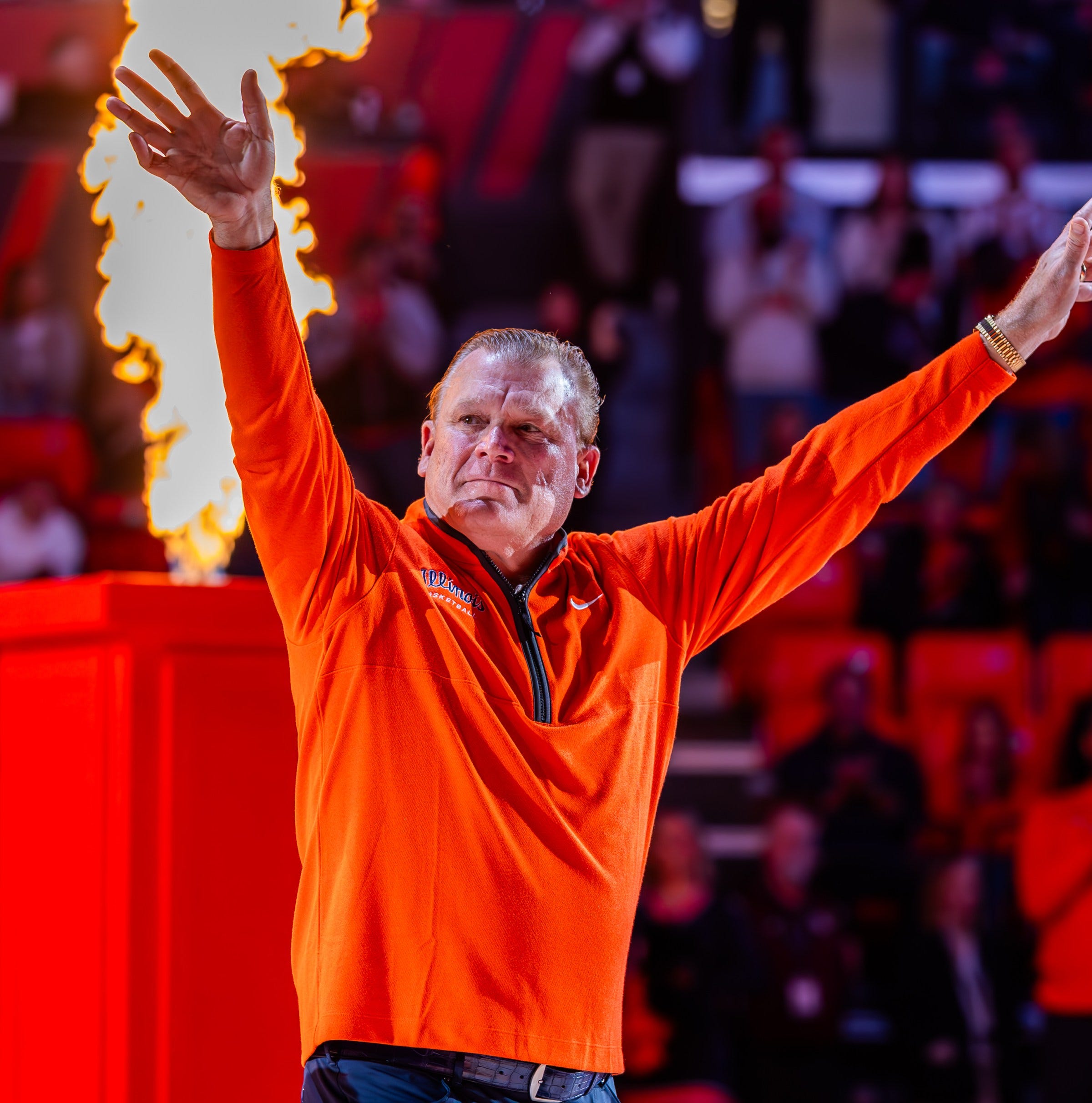
Illinois Fighting Illini
On March 18, 2017, we were sitting in front of a bank of TVs in Bristol, Conn., watching the NCAA Tournament, when the news broke: Brad Underwood had been hired as the next coach at Illinois. We were sitting next to an Illinois fan — and not just any Illinois fan, but John Gasaway, a totemic figure in our own tempo-free understanding of college basketball, and also a friend — and his response was prophetic. He was thrilled. John is reserved, and he practically fist-pumped. He couldn’t have been happier.
We were struck by John’s certainty, but in retrospect it was obvious. Underwood had exceeded expectations every year of his late-blooming head coaching career. He finished 70th, 51st, and 40th in three years at Stephen F. Austin — Stephen F. Austin! — and went to the NCAA Tournament all three times. He took his high-major chance at Oklahoma State, signed a modest contract with an ostensible handshake agreement to raise his pay upon immediate success, was projected to finish 60th in KenPom’s preseason rankings, finished 22nd, went to the tournament, and asked for more (though not that much more) money. Oklahoma State balked. Illinois jumped. And so Underwood became one of the smartest, most opportunistic hires in modern college basketball history. (And, from OSU’s perspective, one of the all-time fumbles.)
Illinois has been good ever since. Underwood had a couple of rebuild years early, but from there — especially at a program without a national title, where Final Fours get treated with epochal reverence, and coming off the Bruce Weber angst and the nondescript John Groce years — the overall standard, not to mention the tactical adaptability and acumen, has been unimpeachable.
Last year’s team was probably his best. It was definitely one of the most efficient offensive teams in modern history, especially once three-star-to-lottery-pick discovery Keaton Wagler fully took over. A big part of Illinois’s ubiquitous top-five rankings in 2026-27 has been about how much of that team is returning: David Mirkovic, Andrej Stojakovic, the Ivisicii, Jake Davis, plus the arrival of five-star guard Quentin Coleman and Providence transfer Stefan Vaaks, an adept Wagler-esque pick and roll operator.
Given all this, for much of the offseason, we expected the Illini to run the whole thing back. Instead, Underwood is ripping it all up. As The Athletic’s CJ Moore detailed Tuesday, this offseason Illinois assistant coach Tyler Underwood found himself intrigued by the balls-out no-screens offense bubbling in NBA circles (and most successfully deployed last season by the Miami Heat), and figured it might be the best way to get the most out of a new backcourt and Mirkovic’s quirky profile, even if it meant completely changing what just made Illinois the best offense in college basketball:
Illinois finished possessions with a pick-and-roll nearly 40 percent of the time, per Synergy’s tracking. The Illini returned five of their eight leading scorers and, ranked No. 3 in the preseason AP Top 25, are on the short list of national title contenders.
So when Underwood brought the possibility of scrapping last year’s offense and trying something totally different to his father, head coach Brad Underwood…
“I’m always skeptical,” Underwood says. “I think head coaches have to be.”
Still, in the end, Brad agreed. Of course he did. This is his greatest quality as a coach. He is always changing. There is zero intellectual ego in him. He is not an ideologue. If Kofi Cockburn is on the team, he will walk the ball up and dump it in the post. When Cockburn’s gone, he’ll go to a five-out. If Wagler drops in his lap, and spends all summer torturing ball screen coverages, Illinois will happily tack back to 295th in adjusted tempo, letting their teenage savant hunt. Wagler goes pro? Fine. Time to run — and ditch screens altogether.
Knowing Underwood, this will likely also work. It’s looked good in exhibitions so far. (It also seems designed to get the best out of Stojakovic, who is a just-OK shooter but gets to the front of the rim as well as any wing in the sport.) But if it doesn’t work, oh well? Underwood will simply adapt again. Either way, Illinois will be great.
The “thank you, Jeremy Fears” tier
Michigan State Spartans
We remain convinced the Big Ten is going to be a very deep conference this season, at least as far as NCAA Tournament bids are concerned. Beyond Illinois, though, we’re not sure we see another national title contender in here. That is the upper limit we envision for Michigan State: Very good team, tons of retention, lots to like, but entering 2026-27 a clear step below the likes of Duke, Florida, Arizona and Illinois. (And maybe a couple others; your mileage may vary. We really like UConn.)
We might feel differently if Jaxon Kohler was still here. Kohler’s multi-tool usefulness — he was an excellent interior defender and an elite rebounder on both ends, but also by far the best pick-and-pop shooter at his size in college basketball — created new dimensions of space and continuity in Michigan State’s half-court attack. Tom Izzo’s biggest offseason question was how he was going to replace Kohler, or if he could, with an honorable mention to fellow senior (though much more conventional) big Carson Cooper.
Early returns on the replacements are mixed. Against Marquette Sunday, Charlotte center Anton Bonke — the team’s highest-profile transfer — played just three minutes. Freshman center Ethan Taylor was scoreless in 13. Sophomore Jesse McCulloch started, played 17 minutes, and had four points and four rebounds. MSU may have a bit more outside-in perimeter shooting this season, especially if freshman Jasiah Jarvis and sophomore Jordan Scott shoot it like they did against the Golden Eagles. But the center spot, such a force multiplier last season, remains an open question.
This might sound a little downbeat for invested fans. (Note: We still think this is the second-best team in the league!) For neutrals, though, it’s almost beside the point. Mostly we’re just thrilled Jeremy Fears is still here.
This is the best guard in the sport. He’s also the type of guard — a guy who throws about three or four jaw-dropping assists per game, a guy with such magical vision he can make an all-seeing TV viewer feel slow in the best possible way — that visually captivates. Great scoring is all well and good, but we see great scorers all the time. Every night is a cascade of highlights of shooters and rim finishers. There is something extra special about a guy who passes the way Fears passes. They are rare and sublime.
For a while, it looked like Fears might really go pro. In the spring and early summer, he and his family made it clear they were not merely testing the waters out of obligation — that his return shouldn’t be taken for granted, that people needed to stop patting him condescendingly on the head. A “screw you guys, I really am that good” draft plunge was a non-zero possibility.
We don’t take Fears for granted. We love watching him play college basketball. However this MSU team shakes out, whether the frontcourt functions or not, we are mostly just grateful this dude is still around.
The “strangest post-title season ever?” tier
Michigan Wolverines
Why did Dusty May leave college basketball? This was a sensitive topic in the 2026 offseason, even if the post-August eligibility madness makes it feel like it happened three years ago. What terrible things did it mean about the college game that such a thing could happen?! Everybody, quick, get accusatory and/or defensive! Blame the chaos!
The reigning national championship coach was, like many of his colleagues, clearly a bit exhausted by the rigors of the current job, even if he was one of the best-adapted for it. But May, a genius on a meteoric rise, unknown less than a decade ago, didn’t decide to retire; he left college to coach Cooper Flagg. You don’t need to be desperate to escape your current job to jump at that opportunity.
Whatever the reasons, May’s surprising-but-also-kind-of-not-surprising decision was unprecedented in the modern history of college basketball — put simply, there are no recent examples of a coach leaving college basketball immediately after winning a national title. (It’s pretty much just Larry Brown in the 1980s. Even Rick Pitino waited until 1997, one year after Kentucky’s title, to jump to the NBA.) The same is true for the program May elevated and then left behind. Michigan is in uncharted waters now.
The Wolverines remain in good hands. Mike Boynton was May’s trusted deputy and hand-picked successor, but he also has experience as a high-major coach, and NCAA and program circumstances had as much to do with his later struggles at Oklahoma State as anything else. He is also a renowned defensive coach. Still, even the biggest Boynton believer must acknowledge that May was a generational virtuoso, and that there are maybe two or three other guys in the entire sport — maybe including the NBA, where May is already innovating — at his level. You simply have to factor charts like this in: