

This is Better Know a Conference, Buzzer’s annual preview series. Between now and Nov. 2, we’ll be writing the detailed stories — a mix of roster breakdowns and overarching narratives, divided into silly tiers — of the 2026-27 season to come.
This year, we’re also running our first ever subscriber sale, where you can get 25% off an annual subscription by clicking here or at the button just below this paragraph. It’s the perfect chance to join the welcoming Buzzer community and get access to everything we write, all year round. One of us! One of us!
Today: The Big 12, where the expanded and pleasingly basketball-oriented conference continues to feature multiple national title contenders, elite talent, a dash of chaos, and only a couple of programs that don’t seem willing to spend any money on the rosters (and yes, you can tell). Let’s jump right in.
The co-favorites tier
Arizona Wildcats
Tommy Lloyd is the man now. Arizona was so great last season — and has been so good from the moment Lloyd, a longtime Gonzaga assistant with zero head coaching experience, arrived — that Lloyd was the spring’s slam-dunk this-is-our-guy candidate at North Carolina, where hires without family ties are unheard of, and whose interest Lloyd promptly parlayed into a godfather deal to remain in Tucson. Successful college coaches have a long history of effectively outranking their athletic directors; Lloyd might be the only guy who has ever had that explicit power written into his contract.
No surprise, then, that Arizona begins yet another season with national title aspirations. It should be a surprise, but it’s not. Between NBA draft entrants and graduations, Lloyd returns only a fraction of the team that won 36 games a season ago, has huge minutes and production gaps to fill and faces plenty of questions about how that transition will actually work, and yet pretty much everybody (this newsletter included) expects Arizona to be freaking awesome again. It’s good to be the man.
Also good: Having arguably the most impactful two-way player in the Big 12 on your roster. Motiejus Krivas isn’t remotely flashy, and his excellence was easy to lose amid the deluge of Arizona’s versatile dominance last season, but he is one of the prime floor-raisers in the sport — a strong 7-foot-2 interior finisher, rim protector and rebounder. He does everything you’d hope for an elite modern college center, all at an extremely high level.
What’s interesting is how much of all that Krivas will now need to do. The 2026 Wildcats were almost overfull in the frontcourt. Freshman Koa Peat was immediately thrust into high usage, and Tobe Awaka, the best rebounder in the country by some margin, came off the bench. (Awaka once had 18 rebounds in 19 minutes played; he never broke the 1:1 ratio, but it was fun to watch him try.) Combined with attacking guard play and great positional size, Arizona controlled both rims and generated so many easy baskets they could afford to attempt just 26.3 percent of their field goals from 3.
It’s not clear that’s how this Arizona team will function. Ivan Kharchenkov — one of Buzzer’s favorite “you feel good when this guy has the ball” players of the season — was essentially a 6-foot-7 guard. There’s a real chance he will slide down to the four for significant minutes this year. Kharchenkov is great and in line for a sophomore breakout in isolation, but how does that slight smallball tweak actually function (assuming it happens)? Can top-40 freshman Cameron Holmes do similar stuff with slightly less recruiting pedigree? Are there any two-big answers among the relatively unknown newcomers (Ugnius Jarusvicius, Evan Otten, Endurance Aiyamenkhue, Mabil Mawut)?
Hmm. This frontcourt feels like Lloyd always left a big, glaring spot open for Peat to return from the draft, a gamble that didn’t pay off when Peat stayed in and barely snuck in the first round. (A shooting coach is already in the process of destroying Peat’s shot mechanic, it seems.) Five-in-five guy R.J. Godfrey was the answer after the Peat plan didn’t work out, but no one knows if he’ll end up playing.
Those aren’t the only questions, either. Save freshman star Caleb Holt, whom everyone we’ve talked to expects to be really good right away, Arizona’s backcourt recruitment was … well, interesting. UNC transfer Derrick Dixon is a 6-foot-5 point guard who shot 40 percent from 3, more than a few of which came on self-created dribble jumpers. You can see him thriving in a fast-paced, open-floor Arizona attack, especially for a team that could have used a dash more perimeter interest last season. But Dixon also attempted a grand total of 30 2-point field goals last season, about 10 percent of Jaden Bradley’s figure, and was a shockingly bad rim finisher for his size. You can forgive a fan base accustomed to the latter for maybe taking some time to get used to the former. Washington transfer J.J. Mandaquit, another quasi-post-hype freshman gamble, is even less of a sure thing.
Still, this is all nitpicking. It’s more interesting to get into the weeds than just wave your hands and say Arizona is good again, but, reminder: Arizona is good again. The frontcourt depth and guard talent/experience might not compare favorably to last season’s roster, but whose would? Lloyd restored Arizona to an annual title contender and made himself the most powerful man in Tucson in the process, and there is zero reason to expect any meaningful detours in 2027.
Houston Cougars
Speaking of “waving your hands and just saying a team is good again,” it’s always helpful, this time of year, to take a step back and take stock of exactly what Kelvin Sampson has done:
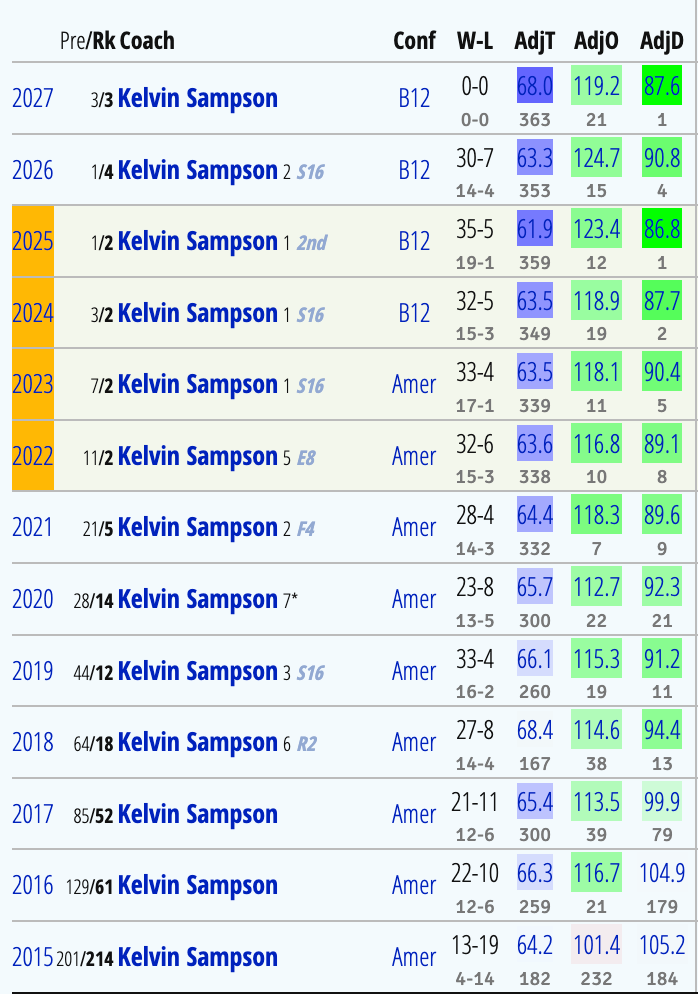
Just completely effing ludicrous. Since COVID, Sampson’s “worst” team finished fifth in adjusted efficiency and went to the Final Four. The level of analytic trust is off the charts: You could tell us Sampson was going to challenge himself by building an entire roster of DIII benchwarmers, or that he’d decided to dedicate an entire season to Norman Dale by fielding just four players in every game, and we’d still have a hard time ranking the Cougars outside the Big 12’s top third.
That is the preface to every Houston preview every season. Houston is always Houston. Houston is always great. The details sort of don’t matter — right up to the point that they do.
Last season’s details ended up mattering. The Cougars returned a big chunk of the team that nearly beat Florida in national title game, but the parts it did not return, especially J’Wan Roberts, ended up being critical. After JoJo Tugler was unable to recreate Roberts’ interior offense — Tugler is many things, but “savvy post operator” is not one of them — Houston abandoned that concept altogether, and instead became an almost entirely outside-in offensive attack. Milos Uzan’s shooting numbers dipped drastically, Kingston Flemings was brilliant but usually stopped well short of the rim, and even freshman big Chris Cenac preferred facing up from range. The result was way too many possessions that ended meekly with Uzan dribbling out the shot clock, and a sudden dip into unrecognizable analytic territory, as Basket Under Review’s Brian Rauf noted of late:
Houston usually sits somewhere in the middle of the power-conference pack in paint scoring and getting to the foul line. Last season it did neither well, finishing around 45 paint points and just under 25 fouls drawn per 100 possessions. That put the Cougars in the lower-left quadrant next to Pitt, Creighton and South Carolina, which is not company Houston usually keeps on offense.
Rauf dug up that stat as context for what comes next, which is to say: Houston really needs Dedan Thomas to be really good, especially at the things Houston did so poorly last year.
The signs are there. Thomas was an elite pick and roll player at LSU last season, one who thrived driving into the teeth of a defense, and one whose assist/turnover rates (43.4% and 11.4%, respectively) were so mind-blowing as to compare favorably to Jeremy Fears. A lot of lob dunks for Tugler should be in the offing. The problem, though, is that Thomas did all of that incredible work in the first 16 games of the season, when LSU was usually playing bad opposition, whereas Thomas was merely solid and not nearly as efficient during the first 58 games of his career at UNLV.
The Cougars desperately the LSU Thomas to be real. If it’s not, it’s hard to see where else the attacking edge will come from. We can safely assume Houston isn’t going to thrust Tugler into the ill-fitting Roberts role again, and Kent State transfer Delrecco Gillespie appears to be more of a “just be long and guard people and grab rebounds” type of guy, at least in the Big 12. Returning wings Mercy Miller and Chase McCarty were both very efficient in around 28 percent of available minutes last season, and McCarty in particular shot the ball well, but neither guy is likely to create. Purdue Fort Wayne guard Corey Hadnot is worth shouting out; he was a high-usage scorer who got to the rim often, even if he looks like little more than a bench spark in this context.
Either way: That’s a lot to put on Thomas’s shoulders. If he’s truly as good as he was when LSU was beating up on overmatched low-majors last season, then the Cougars have their latest Jamal Shead, at least offensively. If Thomas is more like his UNLV version — well, good news, folks: It’s still Houston. It might be the best defensive team in the country again, because those are the table stakes, a team that rebounds everything and plays harder every night than it should be physically possible to play. That is still an amazing floor, as it always is under Sampson, but the difference between “another great Houston team” and “Houston is our pick to win it all” is always down to the shotmaking and offensive creativity — or lack thereof.
The “this could be too low or too high, honestly not sure” tier
Iowa State Cyclones
Tamin Lipsey looms. For opponents — specifically opposing guards, but also opposing coaches — is there any more terrifying five-in-five eligibility decision in the country than Lipsey? Is there any guy fellow college guards want to be ruled definitively ineligible more than this? He’s like the really talented guy at your pickup run that always seems to end up defending you, and then embarrassing you. Go away, Tamin! Guard someone else! Leave us alone!
Lipsey’s eligibility question feels more pronounced than many. If he’s allowed to play this year — and it’s starting to feel more and more unlikely with the five-and-five guys, but we’ll see — then our belief in this Iowa State position goes way up. If not, T.J. Otzelberger has a much more difficult job on his hands, albeit one he’s proven himself plenty capable of.