

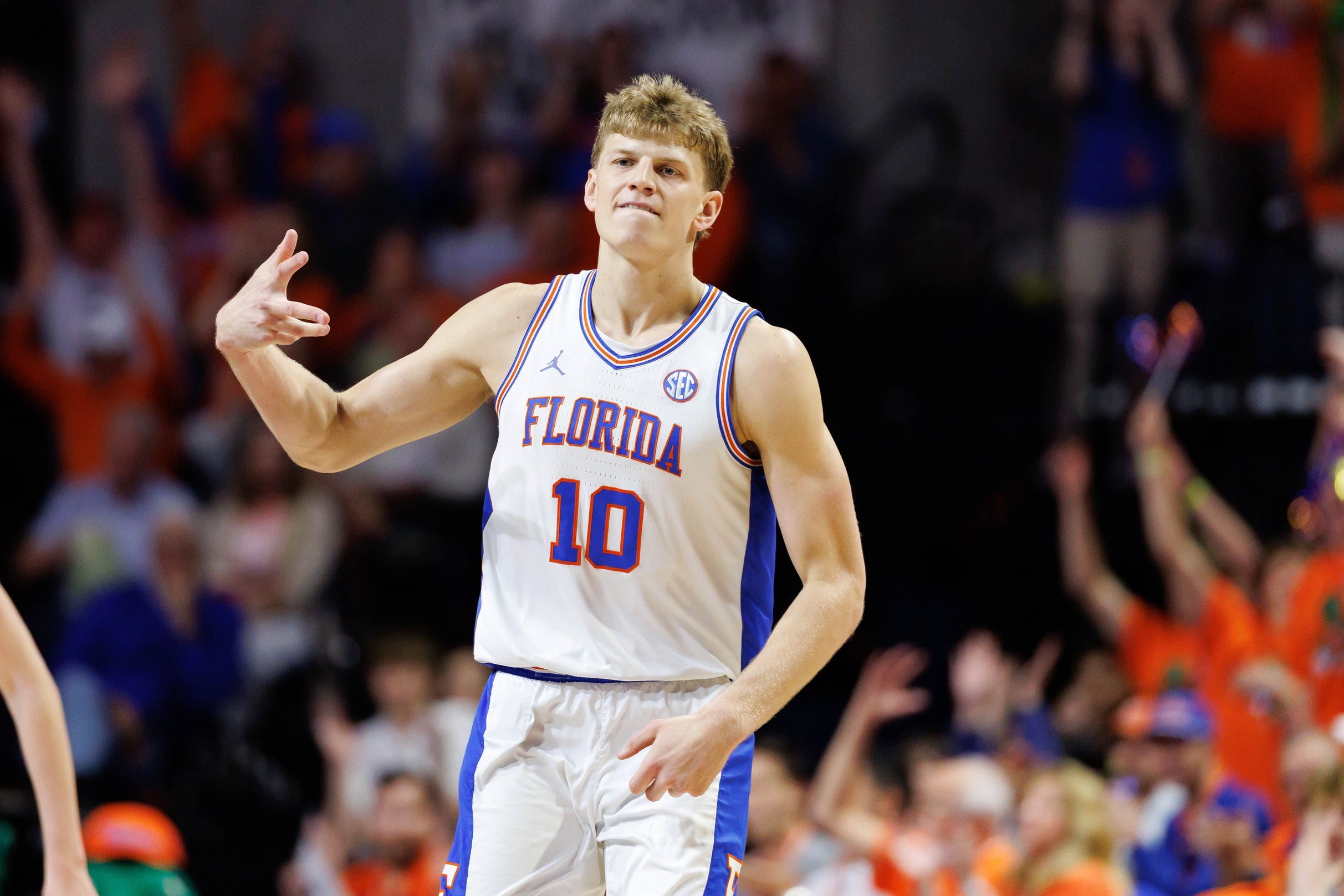
This is Better Know a Conference, Buzzer’s annual preview series. Between now and Nov. 2, we’ll be writing the detailed stories — a mix of roster breakdowns and overarching narratives, divided into silly tiers — of the 2026-27 season to come.
This year, we’re also running our first ever subscriber sale, where you can get 25% off an annual subscription by clicking here or at the button just below this paragraph. It’s the perfect chance to join the welcoming Buzzer community and get access to everything we write, all year round. One of us! One of us!
Today, the SEC, where the supply of roster money is apparently unlimited. (One note: These files are long, so if your email provider cuts off, be sure to click through to the page to read the rest.) Let’s dig in.
The “please don’t freak out about exhibitions” tier
Florida Gators
On Sunday, national title favorite and AP preseason No. 1 Florida lost an exhibition to a Baylor team we just got done projecting as a bottom-half (albeit top-50-ish nationally) Big 12 outfit, which means it’s time to take the very real advice of legendary investor Warren Buffett:

It’s fine. It’s an exhibition game. Everybody’s revving up. Frankly, it could have not been an exhibition game — it could have been the season opener in Rome Nov. 1 — and we wouldn’t have come away all that concerned about Florida. Do you really think Denzel Aberdeen, who went 36.3 percent from 3 on big volume at Kentucky last season, is going to shoot 3-of-17 from the field and 0-of-10 from 3 a lot this season? If so, then sure: panic sell everything right now. Go crazy. If not, take a breath.
(If anything, we came away more impressed with Baylor, particularly Kayden Mingo. If that was real, the Bears are not going to be nearly as underpowered offensively as we surmised even in last week’s preview.)
The fundamentals on Florida haven’t changed. This is the best frontcourt in the country — so good that a year ago Todd Golden converted it to feature three genuine forwards in the lineup almost all the time. The questions then were simple: Could Thomas Haugh be an actual small forward? Would Florida’s spacing get cramped? Could the Gators’ two primary guards, particularly transfers Boogie Fland and Xaivian Lee, handle the ball and make enough perimeter shots without a third viable ballhandler on the floor? Would it matter? Would the output be worth the stylistic squeeze?
We got the answer to all of those questions last season. Florida did not shoot the deep ball well, especially early in the season. Florida turned it over a ton, especially early in the season. And then, gradually, in part because Florida dominated both rims so thoroughly, it all worked anyway: SEC champs, fourth in adjusted efficiency on Selection Sunday, another No. 1 seed. The Gators hammered those three-big lineups basically all the time. They were some of the most efficient in the sport:
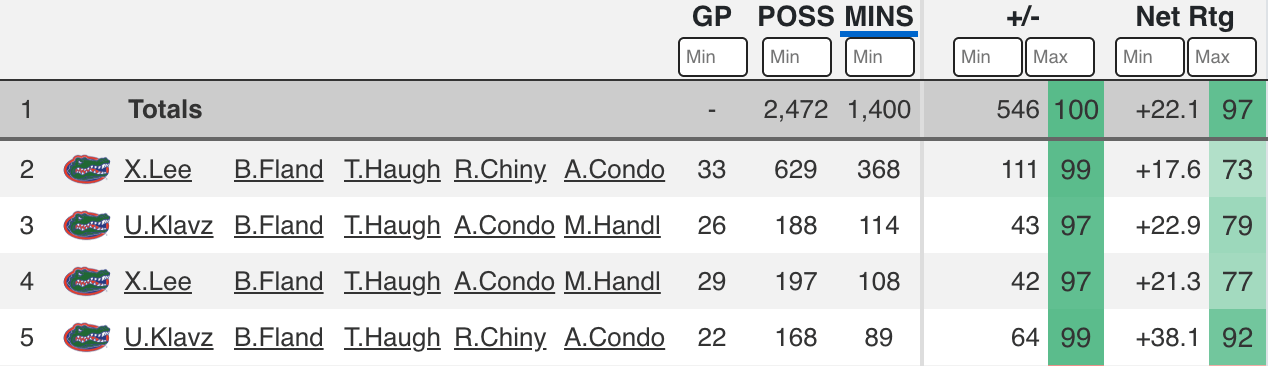
If you want to run back some of the same minor concerns about Florida again this season — and they popped up in UF’s loss to Iowa in the tournament, so it’s not like we’re talking about the perfect team here — that’s reasonable. This will look a lot like last year. Similar foibles will resurface. Fland and Aberdeen will once again shoulder a huge responsibility to make up for what Haugh, for all his strengths at the college level, can’t do, especially with both Rueben Chinyelu and Alex Condon on the floor. Still, Aberdeen is an upgrade on the version of Lee Florida got last year (which is to say: not a great one) in basically every sense. (In the one area you might give Lee the nod, passing and hunting plays off the bounce, Aberdeen showed a new aptitude once he settled into the quasi-point guard role at UK last season.) Urban Klavzar will still be coming off the bench, bringing peskiness and shooting. CJ Ingram (who has a back injury at the moment) and Isaiah Brown will push for wing bench minutes again.
That both of the latter are back says everything about Golden’s work here. We’ve talked about his emphasis on retention this spring, how crazy it is both Condon and Chinyelu are back, how much UF dropped to lure Haugh out of the draft. But it’s one thing to stick around for a ton of money and a starring role. Golden wanted — and was able to convince — in-demand bench players to do it all over again. That takes something else entirely. It’s why the Gators are where they are.
The “all of the other good-to-really-good SEC teams in whatever order you prefer” tier
Tennessee Volunteers
This is a strange new challenge for Rick Barnes. When you think about his tenure at Tennessee, you — ok, we — always come back to two things:
Stylistic consistency, with an emphasis on defense, rebounding, and brawn, and
Veteran program guys
It’s not like Barnes has never used the transfer portal before. He has sprinkled in at least one impact player every season lately: Ja’Kobi Gillespie, Chaz Lanier, Dalton Knecht. All of these guys made Tennessee much better, usually on the offensive end. But that is not this team. This team has two notable returning players, Troy Henderson and DeWayne Brown, who averaged a combined 21 minutes per game last season. That’s it. Otherwise, the Vols are brand new.
Barnes resorting to this gambit probably says a couple of things. One, that he is prepared for this to be the last season of his career, that he knows he doesn’t have time for a multi-year rebuild and after three straight Elite Eights needs at least one more crack at April basketball. And two, that he really likes the guys Tennessee brought in.
As well he should. Tyler Lundblade and Juke Harris are both elite shooters who are excellent off the ball, as Barnes’s teams tend to operate. Point guard Terrence Hill was remarkably efficient in his sophomore leap season at VCU. (Hill had a 128.3 offensive rating on 25 percent usage and a 28.1 percent shot rate, a 23.8 percent assist rate on low turnovers, and elite shooting splits — he was quietly one of the most incisive guards in the country last year.) Jalen Haralson is a big Buzzer favorite heading into this year; he was forced into an overwhelming role at Notre Dame after Markus Burton’s injury, mostly acquitted himself well, and won’t have to do half as much this season to be a value-add. Dai Dai Ames has turned into a useful high-major rotation guy.
Jalen Washington’s status is up in the air, but in any case stealing him from Vandy was a coup, and he’ll do different stuff to the typically stiffer UT-Barnes big. Miles Rubin is more functional, let’s say, but there are questions about how he’d hold up if Washington wasn’t available — and whether Tennessee’s frontcourt can hold up its usual end of the bargain if not.
Regardless, though, there is a free-flowing, fun offensive team here, a who’s who of technically accomplished offensive players. It’s a type of roster Barnes has never really had, or frankly seemed all that inclined to build. The outcome should be fascinating.
Texas Longhorns
This was the first paragraph of the Colorado preview last week:
With respect, it’s hard to say Colorado is rebuilding, per se, because poor Colorado never really gets a chance to rebuild. Every year Tad Boyle’s teams are better than they probably should be; every year he surfaces at least one elite and unheralded talent; every year that guy (or guys) leaves for the NBA or a higher-paying program; and every year, Tad rolls his boulder, no pun intended, back up the Big 12 hill.
Say hello to the chief beneficiary of Tad Boyle’s latest talent identification and development success: Your 2026-27 Texas Longhorns. Isaiah Johnson burst onto the scene as a freshman in Boulder, even into Big 12 play, where he posted a 119.7 offensive rating on 24.4 percent usage with elite finishing stats and a knack for drawing lots of fouls — 5.2 per 40 — without committing them. He was a three-star prospect when he committed to Colorado; one year later, he was one of the biggest and most well-remunerated talents in the portal. And so Tad wiped the sweat off his brow and glanced upward at his task once more.
Johnson’s presence is probably the thing we like most about this Texas roster, but that’s a testament to how much we love the player — there’s plenty else to be excited by. UT retained Matas Vokietaitis, who ranks among the most well-suited modern rim-hovering bigs in the college game. (Even if you didn’t watch much Texas last season, you’ll recall Vokietaitis’s 23 and 16 in a first round win against BYU, part of a tournament run that redeemed the Longhorns’ late-season bubble slide.) Next to him will be 6-foot-7 TCU transfer forward David Punch, one of the best multipositional defenders in college basketball and the perfect you-don’t-need-to-run-a-single-play-for-this-guy scrapper to slot in next to a lot of guys used to a lot of touches. Amari Evans and Elyjah Freeman both feel like Sean Miller-at-Arizona wings, at least on that end. The Longhorns couldn’t guard anyone a season ago, especially early, and somehow managed the trick of fouling all the time without turning anyone over. That problem should be solved. (And Mikey Lewis, who should be a shooter and not much more in this league, is passable there too.)
Oh, and in addition to harvesting underappreciated talent from mom-and-pop programs, Miller also went ahead and recruited the No. 1 freshman class in the country. Marcus Spears is the eighth-ranked player in the class, per 247 Sports; Austin Goosby ranks 19th. Both of them (maybe especially Spears) could be amazing right away. What’s crazy about this roster is that neither of them needs to. Miller could have stuck with Matas plus the incomings, backfilled his bench with a couple of lesser-known up-transfers, and still have looked like a threat to win the SEC. Texas almost has more talent than it needs.
This is the exact sort of thing the Longhorns athletics program had in mind hiring Miller. His second Xavier stint was fine, and his hire wasn’t an overwhelming slam dunk in the moment, but the man has a clear track record of using the resources available to elite programs judiciously. (At least, you know, before the FBI gets involved. Every post-DeAndre Ayton year at 'Zona felt like a guy recruiting with a helicopter flying over his house.)

Miller clearly spent a ton on this team. He spent it well.
Alabama Crimson Tide
You know the deal by now, right? Nate Oats puts talented guards, a versatile wing or big or both, and a rim-running center on the floor. He tells them to spread out. He tells them to ballscreen the bejeesus out of each other and whip the ball around. He tells them to shoot a 3 or get to the rim. They do. Alabama is good. Rinse, repeat.
Oats’s success at Alabama is probably best described as singleminded. This can be a bad thing — the way he handled Brandon Miller, his ludicrous defensive justifications for the Charles Bediako fiasco, his demonstrated willingness to be grating it if means his team keeps winning — but it is also what leads to such perennially successful basketball teams. Oats prunes his garden to his own exact specifications. If he seems a little off-putting in the process, a little ritualistic and dogmatic, rest assured it will come out looking beautiful.