

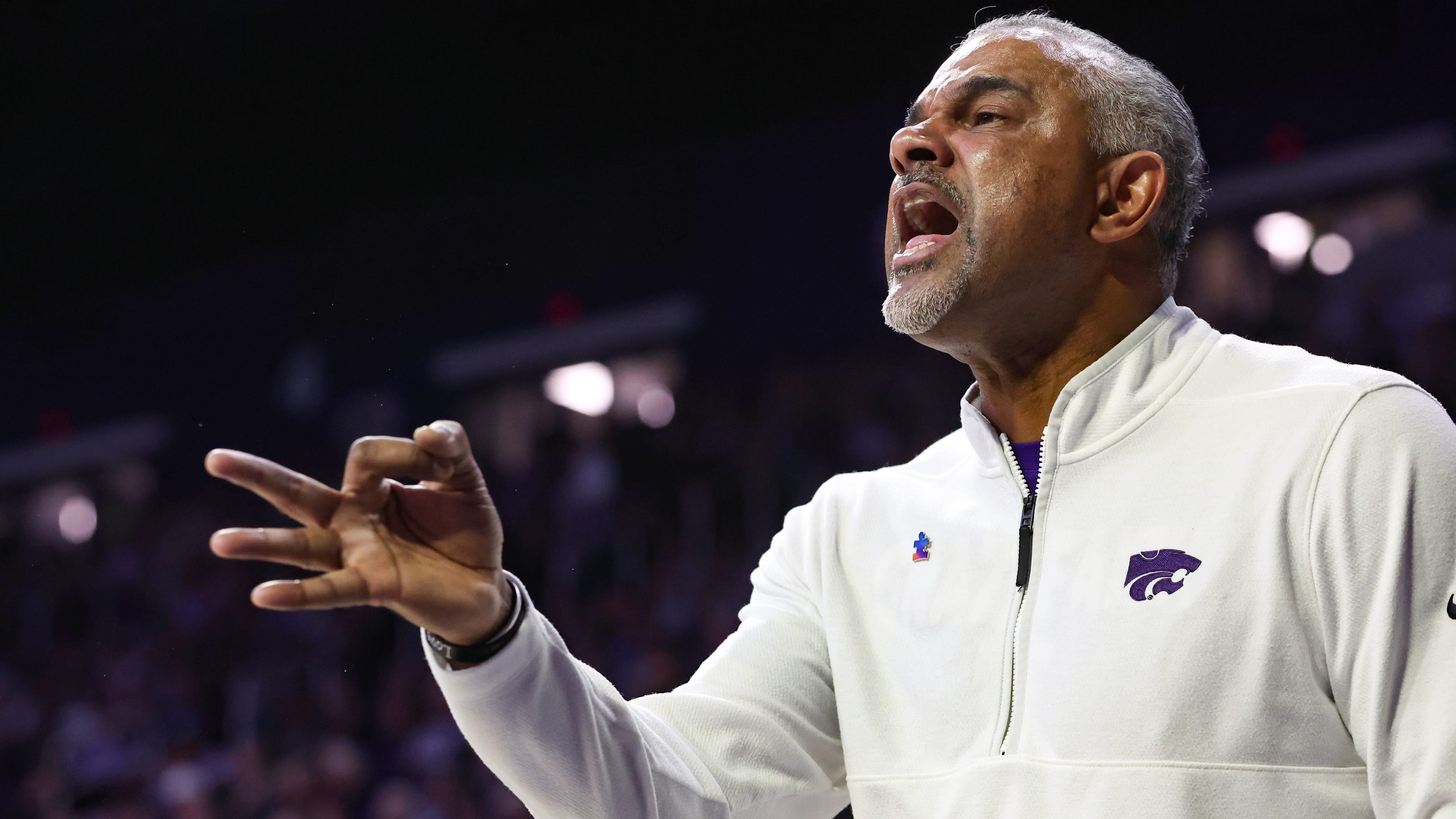
On Jan. 17, 2023, Jerome Tang gave the most famous speech of his Kansas State tenure.
His first Wildcats team had just beaten Kansas — K-State’s first win over KU in four years — and after the students had stormed the court, Tang ran to the Bramlage Coliseum public address mic and delivered a performance for the ages.
“This is not about who we just beat,” he screamed. “This is about us winning.” Then he put a stop to the (expletive) KU chant that had been going on all evening in the student section by leading a chant that involved three simple letters — KSU. “It is amazing what you can accomplish when you do it out of the emotions of love and care and passion,” Tang said.
Then he promised more.
“I told y’all we would get you one court storming,” Tang said. “From here on out, expect to win.”
We thought about that moment a lot the past few days, after news broke that Kansas State was firing Tang — for cause, they told him — following a Feb. 11 press conference in which he said his players “do not deserve to wear this uniform, and there will be very few of them in it next year.” That press conference went viral, which is to say it not only got a lot of clicks but led SportsCenter and PTI, and the widespread negative reaction to it, and not at all the monstrous buyout in the contract he signed with K-State a couple years ago, is what “really concerned” athletic director Gene Taylor, and prompted him to try firing Tang without paying him the $18.67 million the coach would otherwise seem to be owed.
“There’s language in his contract about certain things that could potentially bring embarrassment,” Taylor said. “Basically, his comments about the student-athletes and the negative reaction to those comments from sources, both nationally and locally, is where it kind of felt like I needed to make the decision.”
Tang has lawyered up, those lawyers are already beating the drums of war, and without rendering a legal opinion one way or the other — let’s just say it KSU’s assertions seem like a stretch, but what do we know — what we can say is that absolutely no one standing on that Bramlage court three years and one month ago could have foreseen Tang’s departure going like this.
The funny thing? The stuff that once made K-State fans want to run through a brick wall — that sort of cringey-slash-inspirational speaking schtick, the visit to FAU’s locker room after the 2023 Elite Eight loss, the press conferences about attitude and effort and 6 am practices and guys not earning the right to wear the glorious purple and white, and all the other stuff that seems extra-cool when times are good — was what would eventually drive K-State fans extra-nuts. After three years of failure, people only get sick of you faster, and from what we can gather people there are really sick of Jerome Tang.
But that is always the case. Whether a coach is stoic or verbose, how fans respond is always only ever about whether you win as much as they think you should. In the modern game, those expectations come with a quantifiable monetary value: Are you generating enough NIL budget to recruit quality players? And, if you are, are you using that money to construct quality teams?
This was the real recurring sin of Tang’s K-State.
By all accounts, Wildcats boosters responded to the Elite Eight appearance with robust financial enthusiasm. Every spring under Tang, K-State was always in the conversation for almost every top portal target. It often landed those players. The rosters never made any sense. We still can’t get our head around why Tang made former Illinois forward Coleman Hawkins — a complementary thread-weaver of a player, perfect for the right kind of system but not a star on his own — one of the highest-paid stars in the sport two summers ago, or how he was supposed to pair with Dug McDaniel, exactly, or how Kansas State was going to do anything stylistically differently from the previous season, when the Wildcats were also terrible offensively.
This summer at least made a bit more conceptual sense: If you’re going to go all out for a super-expensive transfer, at least make it someone like P.J. Haggerty, who can have the ball in his hands all the time, run ballscreens, and simplify your offense through sheer individual skill. But that hasn’t worked either, because the rest of the team is still too turnover prone and rim-averse, and in fact the one thing the former Baylor defensive specialist’s teams did reasonably well — guard people — has now vanished from Manhattan entirely.
This is surely what prompted Tang’s outburst last week, when his team gave up 92 points to freaking Cincinnati, this suspicion that the only explanation was a lack of effort. Probably correct! But guess what: It’s also your job to coach effort. It’s your job to recruit guys who will try hard. This is college basketball! That’s all your job!
Sometimes, people act like NIL spending is a guaranteed shortcut to winning, that certain programs can always solve all of their problems with more money, that all you really need is a big pot of cash. It just keeps being wrong. Look around the country. Kentucky spent $22 million on too many players; right now it’s a seven-seed. BYU paid a freshman a gazillion dollars, and boss-moved Rob Wright out of Baylor, but had (apparently) exactly zero dollars left over for usable depth. Texas Tech chose to reup J.T. Toppin but had to let Darrion Williams walk; they haven’t missed a beat. Williams’ new school, NC State, is still suffering from failure to launch. Purdue is never mentioned among the top NIL spenders; the Boilermakers are always good anyway. Nebraska isn’t paying crazy money for its best team in program history. Michigan splurged on Yaxel Lendeborg, sure, but found undervalued bargains around the margins. Virginia spent big on an overhauled roster, but Ryan Odom knew what he wanted and was flexible enough to make it work, and so it has. And on and on.
Every year, the teams that succeed look different. There are so many ways to win. There are so many marginal advantages, and underrated prospects, and types of team you can put together — with players who make sense in lineups together, players you trust to play hard no matter what.
Money helps, sure, but it’s not an exact prerequisite. It only matters if you know how to use it.
However Tang’s contract plays out, and for whatever he did to rhetorically annoy K-State fans along the way, his biggest problem had very little to do with brash proclamations or viral press conferences. It was far more elemental: Modern recruiting is still not about parts. It’s always, and forever, about the whole.
Housekeeping:
For a bunch more Jerome Tang talk, as well as stuff on that brilliant Iowa State-Houston game, the Providence bummer, the great games to come this week, and more, check out the latest episode of the Basket Under Review Podcast (like and subscribe, etc!):
We’ve switched to highlighting WAB (wins above bubble) instead of SOR (strength of record) at the top of team blurbs. There’s not a ton of difference, in terms of reading this Bubble Watch, but the committee leaned on WAB more noticeably in the last couple of Marches (and in-the-room NCAA folks are now openly suggesting broadcasters pay more attention to it, like, yesterday), so it’s worth emphasizing.
Some email providers impose limits on email length. This is a long file, so if your email cuts off, be sure to click through to the site itself to read it all.
There are almost certainly typos in the below copy. We are our only editor; this is a one-man show. If you spot factual mistakes or just think we should consider a team not on the page, get in touch in the comments or shoot me a note.
NET and WAB are always current as of the previous day. Records are always up to date. Thanks as ever to Warren Nolan for his immensely helpful site.
We wrote all of this, by hand, as nature intended. If you would like to support these efforts (and be able to comment, and join the live chats, and — at the founding tier — do a regular Zoom call with us to talk hoops) please consider a paid subscription today. Thanks!
ACC
It’s Feb. 17, and Virginia is a lock. This is hardly an Earth-melting hot take, given the Cavaliers’ steady campaign. But if you zoom all the way out — back to, say, last spring, or even to the fall of 2024, when Tony Bennett abruptly ended his career — it’s pretty freaking incredible.
Bennett’s retirement was a huge blow. For UVa fans, especially those raised on the previous decade, it would have felt like Virginia basketball itself was over. The two were synonymous. Bennett’s principles were infused into every nook and cranny. Slow pace, pack-line defense, slow-burn roster builds, redshirt projects, collective development: They were always anachronistic ideas, but they worked, right up to the point they didn’t.
But there was very little evidence that a new, modern, transfer-heavy approach would work at Virginia, either. Bennett’s aversion to overt NIL spending made it unclear whether the program would be able to marshal competitive resources if he left. Even if they did, it was an open question whether any replacement could rebuild a roster quickly enough to win right away, without making fans feel like they didn’t recognize their program at all.
Ryan Odom pulled it all off. In his low-key, straightforward way, Odom paid homage to Bennett and to his underlying program pillars … while also absorbing a pent-up NIL supply and deployed it masterfully. He and his staff built a balanced, veteran roster from every which direction: big international prospects, mid-major up-transfers, pedigreed talent once recruited by bluebloods. (He also re-recruited Charlottesville native Chance Mallory, who is even better than anyone thought, and looks like the foundation of the program long after the current wave of guys are gone — a player with whom fans can fall unreservedly in love.) At 22-3, Odom has won enough already this season to prove Virginia doesn’t have to be any one thing. A new era has arrived.
Lock: Duke, Virginia
Should be in: Louisville, North Carolina, Clemson
Work to do: NC State, Miami, SMU, Virginia Tech, California
Louisville (19-6, 8-4; NET: 12, WAB: 21): Mikel Brown’s last two games, a 118-77 (!) win over NC State and Saturday’s more perfunctory victory over Baylor: 74 points, 12 rebounds, eight assists, eight steals, 8-of-16 from 2, 14-of-21 from 3. Ell. Oh. Ell. Expecting Brown to maintain that sort of pace is silly, but it certainly bodes well for Louisville’s ceiling moving forward, and it recontextualizes the feels-like-it-should-be-better team sheet: four of this team’s six defeats came when Brown was injured in January. It wouldn’t be a total surprise if the committee ends up slotting the Cardinals a bit higher up the curve than many mock brackets are currently accounting for.