

A truly remarkable thing happened Monday evening: The NCAA won a case in court! Cue the meme!
This one was important, though. Tuscaloosa County Circuit Court Judge Daniel F. Pruet found in favor of the NCAA and denied Alabama player Charles Bediako’s motion for a preliminary injunction, which is a fancy lawyerin’ talk way to say Bediako’s absurd five-game return to college basketball — after entering the draft in 2023, knowingly forgoing his eligibility, dropping out of the G League last month, and obtaining a temporary restraining order from a sympathetic local judge to break NCAA rules — is mercifully over.
The judgement, that Bediako could not have had a “reasonable expectation” to be the first guy allowed to break a very clear NCAA rule was, if not scathing, resoundingly straightforward in its dismissal of Alabama’s nonsense:
“The rules do not permit a student-athlete to participate in college basketball, leave for the NBA, and return to the collegiate arena. All the evidence in the record indicates the Defendant has consistently applied this specific rule, and, that as it relates to the Plaintiff, the Defendant has applied the rule as written. … The Plaintiff failed to point to any evidence that the Defendant has inconsistently applied the rule at issue.” […]
“To obtain the benefits promised to him for participation in NCAA basketball, the Plaintiff must be eligible to participate in NCAA basketball. Eligibility to participate in the NCAA is controlled by the Defendant’s application of the eligibility rules legislated by the NCAA membership.”
It’s almost like Nate Oats was sitting in the court behind the plaintiff’s table — as if Judge Pruet, like that early courtroom scene with Stringer and McNulty, was pointedly addressing a few choice suits in the gallery. This was highly satisfying.
Why? Since Bediako was force-declared eligible, Oats has been doing the thing that unpopular politicians do when they’re on the illogical and losing side of a clear-cut argument: hammer talking points, muddy the waters, create false equivalences, whatabout everything. He has constantly, shamelessly insisted that Bediako is no different from any of the European-born players now on college rosters — who have a vastly different non-amateur development landscape, and always have, which Oats well knows — or even Baylor’s James Nnaji, who crucially never went to college or forfeited any eligibility. For weeks, Alabama’s head men’s basketball coach has been intentionally intellectually dishonest, all for the sake of adding a pretty good center to his roster.
Alabama athletics director Greg Byrne backed Oats publicly. Remarkably, SEC commissioner Greg Sankey — as powerful a person as there is in college athletics — did not. Sankey said in a Feb. 5 affidavit to the court that “inconsistent application of the NCAA eligibility rules challenged in this case … fuels disruption in college sports.”
Oats never directly responded to questions about Sankey’s affidavit, because Oats is not that crazy. One does not openly criticize Greg Sankey. Asked about Sankey Feb. 6, the sudden freedom fighter said he was mostly just “really disappointed with all the eligibility issues and inconsistencies in the entire system” and that “Charles seems to be the one where all the focus is, because there’s plenty of others who have been made eligible.” Oh, yeah. He’s the focus? How did that happen?
Then Monday’s judgement happened. Surely, now, Oats would drop the kayfabe and admit the real situation here, which is that he was hunting every possible marginal advantage to win basketball games, as he does, and happily saying anything he thought would advance that effort, and it didn’t work out, but hey aw shucks well look can you blame us for trying.
Nope! Still tripling down:
“Disappointed in the ruling. Disappointed in the system — both the NCAA, the courts, the whole thing, just with all the inconsistencies with who’s eligible and who’s not. It just seems like the European international players are being given preferential treatment over the Americans. It more so happened today. Hopefully, at some point, somebody is going to win a ruling like this. It wasn’t here today. At some point somebody will win one and change the system. Because that’s how it has to get changed in the NCAA. They don’t make changes on their own, typically.”
Still hammering the “but what about these Euros, can we trust them, are they getting preferential treatment?” angle. Still attempting to defend the huddled masses of undiscovered American basketball prospects he suddenly weeps for. (Bediako is Canadian, by the way, not that there’s anything wrong with that.) Still talking like a dorm room liberation theorist when the fact of the matter is this happened because Nate Oats thought he could eke out a few more wins with a former player-turned-pro on his roster, if only he could venue-shop the case to a friendly judge who would say aw, hell, go win some ball games, with zero interest in how the consequences of that action would affect anyone but him.
The entire affair was a farce. We all knew it. Oats knew it. Again: He is not dumb. He knows the differences between the European and North American basketball development pipelines. He knows what the rules are. His goofy, raspy waffling these past few weeks was transparently ludicrous to anyone with a brain, him included, and for what? To go 3-2? To narrowly beat Texas A&M and Auburn? To make sure you a) do nothing material to advance your own team’s tournament chances and b) poison the broader competitive well? Cool.
When is the last time a prominent coach hurt his own reputation this badly? Most of all: How bad is your case if you lose to the NCAA?
Housekeeping:
We’ve switched to highlighting WAB (wins above bubble) instead of SOR (strength of record) at the top of team blurbs. There’s not a ton of difference, in terms of reading this Bubble Watch, but the committee leaned on WAB more noticeably in the last couple of Marches (and in-the-room NCAA folks are now openly suggesting broadcasters pay more attention to it, like, yesterday), so it’s worth emphasizing.
Some email providers impose limits on email length. This is a long file, so if your email cuts off, be sure to click through to the site itself to read it all.
There are almost certainly typos in the below copy. We are our only editor; this is a one-man show. If you spot factual mistakes or just think we should consider a team not on the page, get in touch in the comments or shoot me a note.
NET and
SORWAB are always current as of the previous day. Records are always up to date. Thanks as ever to Warren Nolan for his immensely helpful site.We talked about Oats and Alabama — and also Arizona and Kansas, and a bunch else besides — at length on this week’s Basket Under Review Podcast. Check it out! Like, subscribe, etc!
We wrote all of this, by hand, as nature intended. If you would like to support these efforts (and be able to comment, and join the live chats, and — at the founding tier — do a regular Zoom call with us to talk hoops) please consider a paid subscription today. Thanks!
ACC
One of the many incredibly fun things about the UNC-Duke rivalry — which is really just mind-melting in its ratio of classic games; every time you think it’s a cliche another moment like Saturday night happens — is that it’s so crazy and emotionally charged, such a magnet for insanity, that if you’re a fan of the losing team you can rationally set it to one side. Like, it hurts, of course. Duke fans must be absolutely devastated, even now. And maybe there are some qualitatively conversations to be had, some concerns about mental strength or whatever. But as a neutral, do we feel any worse about Duke after that loss? Do we feel any less like this is one of a handful of extremely good, extremely obvious national title contenders? Not in the slightest. It’s Duke-UNC, or UNC-Duke. There is a dark alchemy to this rivalry. Strange forces play on it. Sometimes it feels like it’s barely about the actual basketball itself.
Lock: Duke
Should be in: Virginia, Louisville, North Carolina, Clemson
Work to do: NC State, SMU, Miami, Virginia Tech, California, Stanford
Virginia (20-3, 9-2; NET: 16, WAB: 18): For all of the impressive rapid-fire recruitment first-year coach Ryan Odom did in the portal last spring, it’s possible his best acquisition came the old fashioned way. Seriously: How good is freshman guard Chance Mallory? The 5-foot-10 Charlottesville native had already committed to UVa when Odom arrived, and always felt like the kind of kid who just needed to hear some reassuring things from the new staff before he formally reupped with his hometown school. Still, these things are never guaranteed. Mallory would have had other options. But Odom got him back on board, and has been rewarded with a freshman exceeding all expectations. Mallory is arguably already the best sixth man in the country in his 61.1 percent of available minutes played; he’s a sharp, low-turnover ballhandler who also creates tons of steals, can score from just about everywhere, and draws free throws at the highest rate on the team. Virginia not only doesn’t remotely fall off when he plays, but actually gains different strengths from his presence. He’s already arguably better than both Malik Thomas and Dallin Hall; he’s certainly been cleaner on the ball than the latter, which no one would have seen coming. And while much of Virginia’s all-new roster could end up elsewhere next season, Mallory profiles as a stayer — the kind of kid you can build your roster around, the kind UVa fans will fall head over heels for, if they haven’t already.
Louisville (18-6, 8-4; NET: 17, WAB: 25): There is not a great deal to say about Monday’s gazillion-point win over NC State but this:
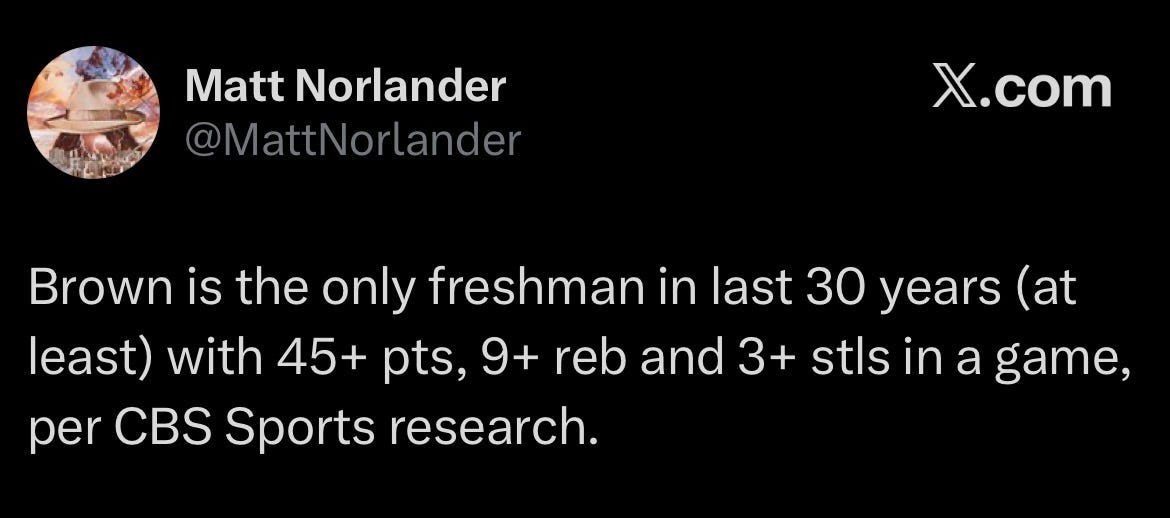
Ryan Conwell also had 31 points on 14 attempts. Will Wade’s postgame press conference was predictably funny, more on which below.
North Carolina (19-4, 7-3; NET: 24, WAB: 17): None of anything in today’s ACC intro was intended to minimize Carolina’s accomplishment, by the way. The Tar Heels deserved that win, and deserved to celebrate like maniacs after it (with the caveat that UNC facilities people should do a better job getting opposing players off the floor, with the additional caveat that it is not a place particularly used to storming the court, and a buzzer-beating game winner is bound to incite an unusual level of chaos at any gym.) What stuck out most to us? Seth Trimble’s winner will be the highlight that gets added to the historic ESPN hype packages, but anyone who goes back and watches the full 40 minutes (which, presumably, every UNC fan has already done) will put Caleb Wilson right next to him in the pantheon of UNC’s single-game rivalry greats. Wilson did some ridiculous stuff in this game. The shot below, at the 2:30 mark in the extended highlights, was the non-Trimble play of the night …
… and not just because of the degree of difficulty. Duke led 18-5 at that point. That make was already crucial. The Tar Heels then got a stop, posted Wilson again, and he made a beautiful step-through 2 (against Maliq Brown, of all people) that cut the lead to nine. Wilson had another one over Cam Boozer at the 11:13 mark, down 22-11. His 3 a minute later made it 22-19. Things could have gotten bad early. Duke was good enough to shut the whole occasion down. Wilson was often the only UNC player who looked like he belonged on the same court. His brilliance kept the Tar Heels afloat long enough for that second half to happen. What a player.