

To be a fan of college basketball in 2026 is to live out a nightly paradox: The games have never been better. Everything around the games has never been so weird.
Nobody knows who’s eligible. The NCAA lacks the power to enforce its own rules. The tournament is probably going to expand, either next year or the year after or the after that, which almost nobody who consumes the product seems to want, but which will happen anyway. Nobody wants power conferences to consolidate and monopolize, but they keep blobbing, France in EUIV-style, across the map all the same. Nobody knows exactly how players are going to get paid next year, or how much, or whether any of this is legal, or whether any of it will still be legal in two or three or five years. You can follow this sport intensely and still feel totally confused and adrift, alienated by one jarring news cycle after another.
And then you can sit down at 7 p.m. ET on any given night and watch some of the best college basketball you’ve ever seen, and suddenly none of the rest of that stuff stays in your head for one minute more.
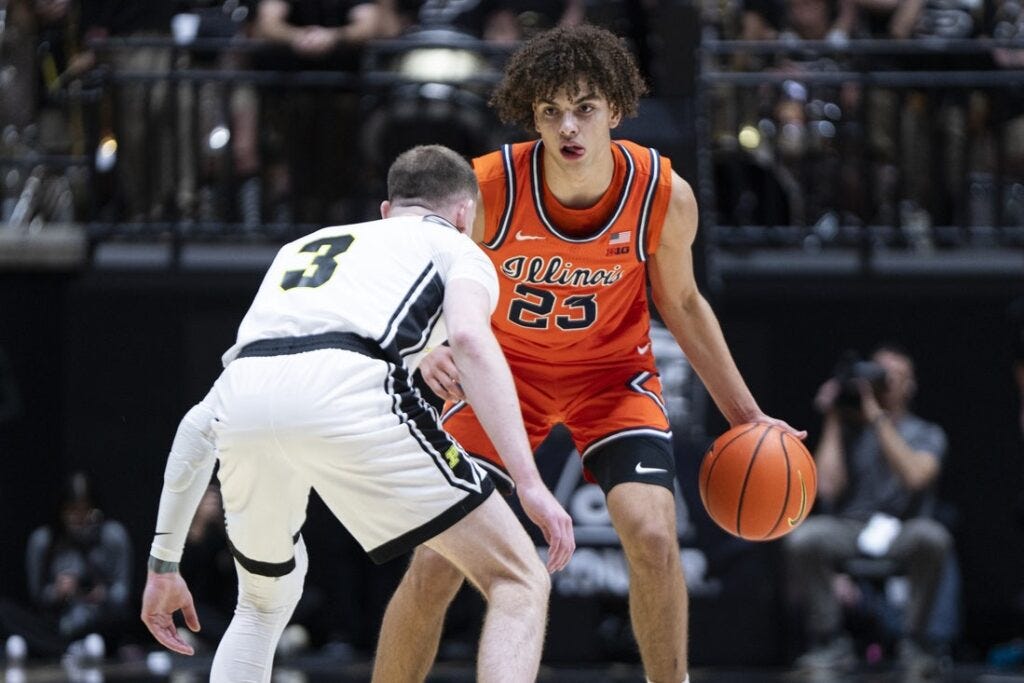
That has been our experience this year. It is similar to recent seasons, but dialed up to 11. The superstructure that surrounds the basketball it keeps getting more bizarre. Not bad, even; just stranger and more difficult to understand. But then you go back to the games, and look at this. The coaches keep getting smarter. Their teams keep playing harder. Their styles diversify and proliferate. Their players get ever more proficient, more surprising, more advanced. Saint Louis wins again. Miami (OH) survives again. An incredible class of future pros does something you’re not sure you’ve ever seen before. Keaton Wagler comes out of nowhere, with his gangly limbs and his fluffy hair, and, well, just look at him. How good is this?
That’s what has kept us optimistic about the much maligned, quote-unquote, State of Our Game — even when we’re low-level annoyed that Iowa is playing Oregon in a conference game, or grumpy about a judge that just wrote his own new NCAA rule, or worried that NCAA Tournament expansion will suck. There’s always another game, another reminder of what the point of all this other nonsense really is. That part is eternal. It’s sacred. It’s way too good to mess up.
It is in that same spirit we bring you Buzzer’s first Bubble Watch of 2026. Huzzah! Cue trumpets, etc. We’re back.
We’ve been doing this column a very long time. Unlike the sport it covers, it has remained mostly unchanged. It is a simultaneous countdown to, and forecast of, the greatest tournament in sports — and also a weekly snapshot of the entire sport in all of its chaotic and sublime glory.
It’s also long, so we should just get into it now, but some important housekeeping notes:
We’re switching to noting WAB (wins above bubble) instead of SOR (strength of record) in the team blurbs. There’s not a ton of difference, but the committee has seemed to lean on WAB more noticeably in the last couple of Marches, so it’s probably worth emphasizing here as well.
Some email providers impose limits on email length. This is a long file, so if your email cuts off, be sure to click through to the site itself to read it all.
There are almost certainly typos in the below copy. We are our only editor; this is a one-man show. If you spot factual mistakes or just think we should consider a team not on the page, get in touch in the comments or shoot me a note.
NET and SOR are always current as of the previous day. Records are always up to date. Thanks as ever to Warren Nolan for his immensely helpful site.
We wrote all of this, by hand, as nature intended. If you would like to support these efforts (and be able to comment, and join the live chats, and — at the founding tier — do a regular Zoom call with us to talk hoops) please consider a paid subscription today. Thanks!
ACC
Jamal Mashburn said something wild the other day:

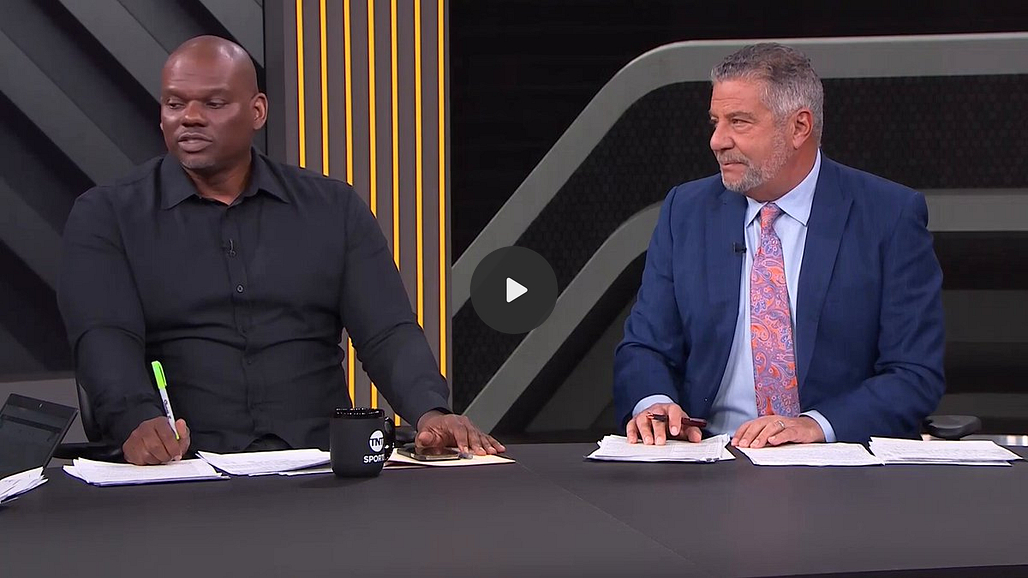
The current crop of freshmen is incredible, no doubt, and going to be a recurring focus of this column until the season is over. It’s not the first time we’ve seen someone say this about Flagg, either: Some NBA executives were telling reporters similar stuff earlier this season, presumably the same NBA executives who once drafted James Nnaji 31st overall.
This is extremely silly.
It would be defensible if last year’s No. 1 overall pick was still a super-hyped rising senior who hadn’t stepped on a college court, whose status got bumped back by a surprisingly loaded 2026 class, where NBA GMs were reorienting their long-term tanking strategies for a chance at Darryn Peterson. In the real world, though, Flagg is already an NBA player — a really freaking good one. He just scored 49 points in a basketball game! He is 19! HAS THE WHOLE WORLD GONE CRAZY?!
We just watched Cooper Flagg play college basketball for an entire, interrupted, uninjured college season. His freshman year was every bit as good as Zion Williamson’s. He was probably the best freshman since Anthony Davis. This was just last year! We were there! We were in San Antonio! We remember it! Maybe you, or Mashburn, or the anonymous NBA executive, or whoever, really love Peterson. Fine. When he plays, he’s ludicrously good. But, knowing what we know right now — which again includes the knowledge that the 19-YEAR-OLD 6-FOOT-9 OSTENSIBLE POINT FORWARD COOPER FLAGG IS ALREADY A REALLY GOOD PROFESSIONAL BASKETBALL PLAYER — who else in this class are you confidently taking over Flagg? A.J. Dybantsa? Really? If you’re an NBA GM with your job on the line, you make that call? You’re sure?
This is a great class. Insane class. The number of good freshmen this year is crazy, to the point that we forget about lots of them. But the Flagg thing needs to stop.
All of which is our roundabout way of saying the world continues to sleep on Cam Boozer. Maybe “sleep on” isn’t the right phrase; maybe it’s more like “quietly accept.” Boozer is a profoundly strange one-and-done sensation, mostly because he looks and plays like a classic college basketball veteran. He seems 22. He is big but not particularly rangy; super-skilled but not overwhelmingly athletic. He can look a little stiff. Despite the lofty mock draft spots, he plays like the kind of guy you assume NBA scouts would traditionally dismiss (maybe besides the passing, which is visibly great). And yet:
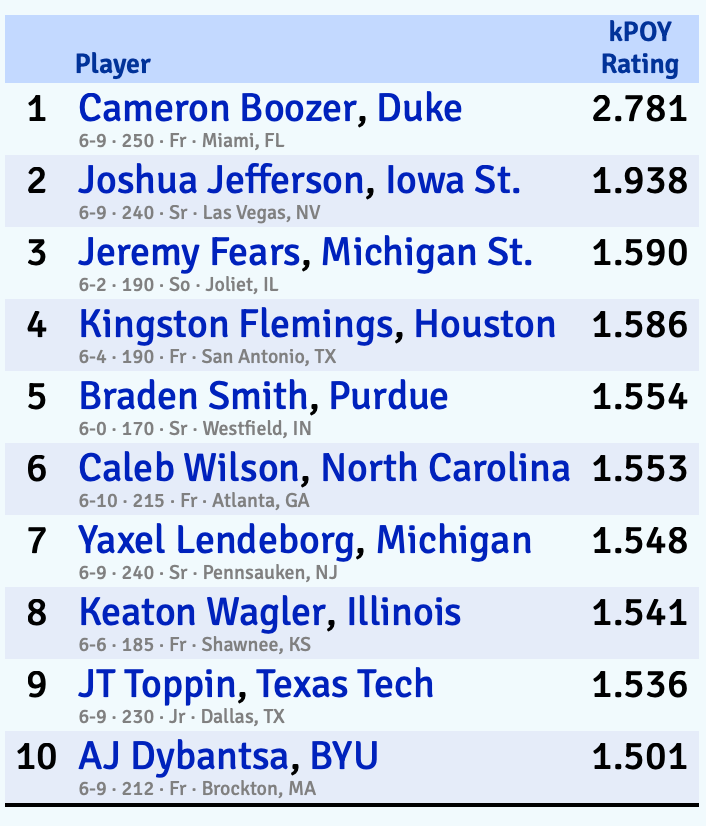
Boozer is averaging 23.5 points (on 14.1 field goal attempts), 9.8 rebounds, four assists and 1.8 steals per game. Duke could easily finish the regular season with one loss. This is the best player in the country, it’s not particularly close, he’s grinding everyone in this improved ACC into a fine powder, and — unlike his predecessor — the gulf between how productive he is and how many highlights he’s generated is brain-breakingly wide.
Lock: Duke
Should be in: Louisville, Virginia, North Carolina, Clemson
Work to do: NC State, SMU, Miami, California, Virginia Tech, Stanford
Louisville (15-6, 5-4; NET: 17, WAB: 26): One of our regular Substack live chatters, a Louisville fan, has been driven routinely nuts by this Cardinals team. We joke with him, but we also get it. The squad is clearly really talented, but turnovers and missed 3s can grate, and all of the fun uptempo running and spacing and perimeter shooting and Mikel Brown slashes don’t always make up for a lack of of strength and heft, at least perceptually, especially when you’re not beating quality teams as often as your NIL spend suggests you should. For as much as we like the idea of this group, and think Saturday over SMU was a positive step, there just aren’t a bunch of good wins here, at least not yet, which is why you see a team with these metrics in similar bracket tiers as Clemson and St. John’s.