

Call us old-fashioned, but the Champions Classic still feels like the real start of the college basketball season to us.
It has consistently delivered on its founding intent: a marquee capital-E Event that could attract an opening-week audience broader than sickos, and one that didn’t suffer from an inferiority complex. Unlike many such attempts of its era, the Champions Classic didn’t imply people would only watch if the college basketball was incidental to some wacky logistical gimmick. (Aircraft carriers are super cool! Not ideal venues for ball sports, it turned out.) Four good teams, two good games, one regular old basketball arena in a major American city. Simple. The thing itself was more than enough.
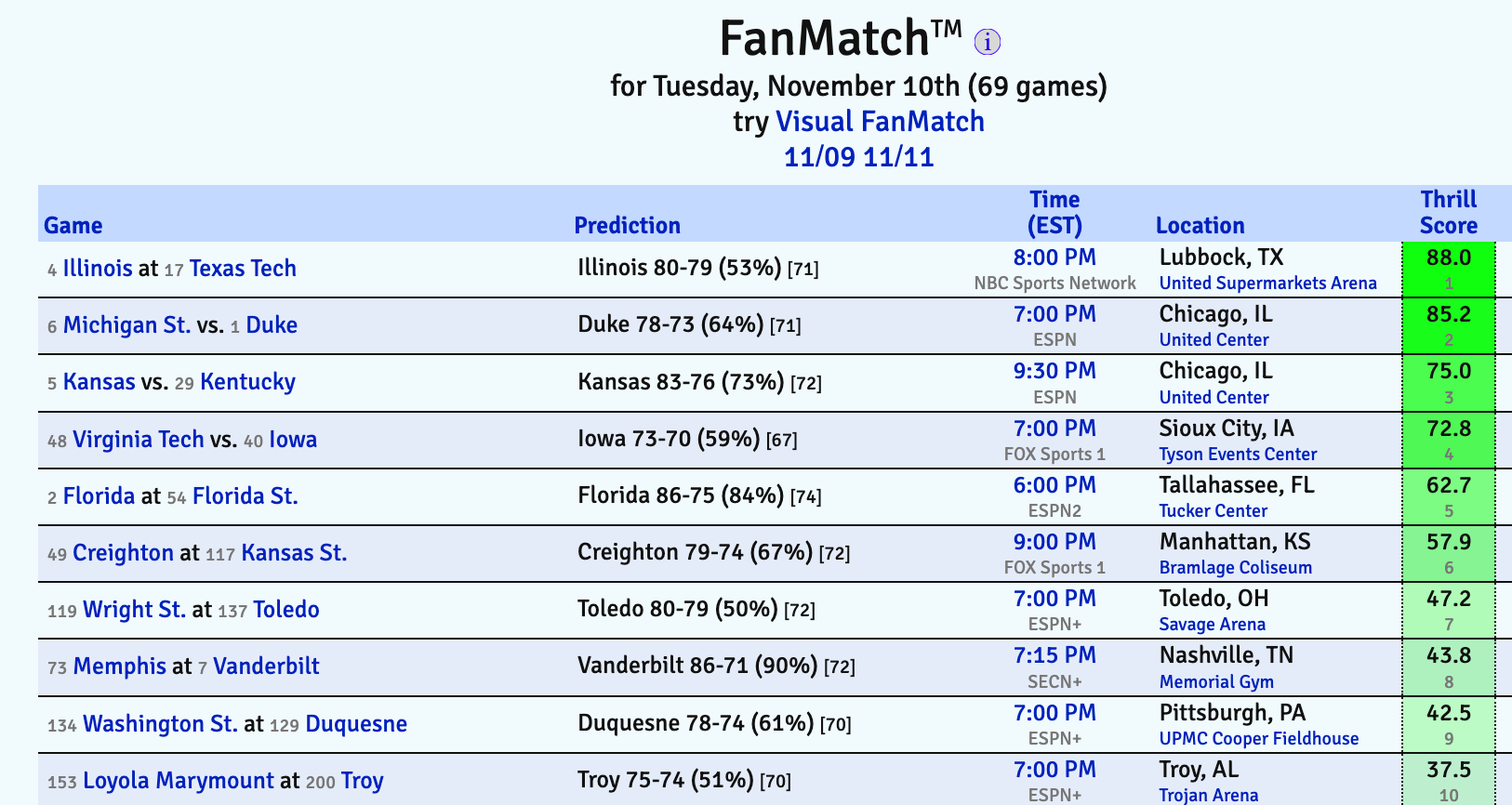
The November calendar has since blossomed. The scheduling window starts earlier, and many coaches no longer wait until now to play meaningful opposition. This season, it has at least felt like there’s been more good first-week basketball than ever, and not just because a couple of low-major underdogs staged wild upsets. There are just good games on all the time. Even Tuesday night was an example: Coming in, despite having Michigan State-Duke and Kansas-Kentucky on the docket, KenPom rated Illinois-Texas Tech as the best game of the night. And correctly so!
Still, the Champions Classic has been so successful it is now ingrained in the collective hoops psyche. It is how we measure the stages of every new season. It is as much a ritual as Feast Week or league play after the New Year. After a grueling offseason, the Champions Classic is still how we know we’re really, unmistakably, all the freakin’ way back.
As such, it’s the right time to take stock and line up everything we’ve noted from the first 10-ish days of the 2026-27 season — including thoughts on the Champions Classic itself, the limits of Illinois’s offensive radicalism, a pleasant surprise at UCLA, peak UConn, Penny Hardaway’s new dawn, Minnesota looking real, Virginia and Vanderbilt picking up where they left off, and how all of that roster chaos we thought might ruin this season basically just … faded away.
Also: early bubble implications! No, seriously!
Let’s get into it.
Tom Izzo and Jeremy Fears just put on a clinic
In advance, the obvious read on Michigan State-Duke was that to have a real chance the Spartans would have to dictate the terms of engagement. More specifically, they’d have to drag the game into the mud. Duke is loaded with rangy talent, Duke wants to run and flow, Duke has the ninth-shortest average possession length in Division I — and that was absolutely not the game Michigan State could allow themselves to play. They had to swarm the ball, guard like crazy around the rim, grind things to a halt, and then let Jeremy Fears stand out top, survey the gaps, and pick a settled defense apart.
It was a lot to ask. Naturally, it’s exactly what Michigan State did. They did it all perfectly.
It is possible you won’t see a team — and namely a coach and his point guard — manage a game better all season. It was a total clinic. Duke never led in the game. Duke shot 13-of-31 from inside the arc, the vast majority of which were challenged attempts around the rim. Just three Duke players made at least one of their 29 deep attempts; John Blackwell needed 11 3s to get his four makes. There were some open misses, sure, but there were no easy baskets to turn to as a remedy for an off night out top; the official box score had Duke as 8-of-21 on “layups.”
Jordan Scott had six blocks. The Blue Devils scored 73 points in 73 trips overall, which is about as inefficient as they’ve ever been under Jon Scheyer, but they averaged just .76 per possession in the first half. MSU didn’t just drag the game into the mud defensively; they coated it in toxic environmental sludge.
Then, on the other end, Fears was the clear national player of the year to date — a one-man offensive engine. Whatever Duke did, however it adjusted, Fears immediately, casually found the counter. Michigan State clearly planned to attack Joaquim Boumtje Boumtje defensively, and the 17-year-old predictably looked overwhelmed, but that was true of almost any Duke defender exposed to a Fears ballscreen, trying to see as many permutations as the guy with the ball in his hands. Fears was Neo at the end of The Matrix, flicking away every punch, bemused at how easy this has all become.
(Fern Gully and Matrix mentions in back to back paragraphs. These are the timely cultural references the Buzzer readership craves.)
Anyway, it was incredibly impressive. Total control. Mastery of understanding and execution. God, we love watching Jeremy Fears.
Kentucky is back in the washing machine
Hey guys. Remember this?

A year ago at this time, UK’s coaches and players were walking around in a haze, eyes glazed and glossy, mumbling cryptically about chemistry and emotional connection and, most of all, whether the guys on a $22 million roster actually cared about winning and losing. It was a disaster. Fans were livid. Mark Pope eventually turned it around, but only relative to a funereal November and December; Kentucky quietly finished as a No. 7 seed. My podcast partner, Tate Frazier, has argued that the Pope era at Kentucky finished right then and there — that once you lose your forward momentum, and the faith of Big Blue Nation, there’s no coming back.
He may be onto something. A year later, Kentucky is right back where it was.

