

Earlier this week, my former colleagues at The Athletic dropped what the kids these days might refer to as a truth nuke.
Having spent a weekend anonymously polling coaches at Peach Jam, asking those coaches to estimate the average NIL spends of conference competitors, Brendan Marks and CJ Moore returned with figures that were somehow both eye-watering and — based on everything everyone in the sport was saying all spring — entirely plausible, if not outright predictable:
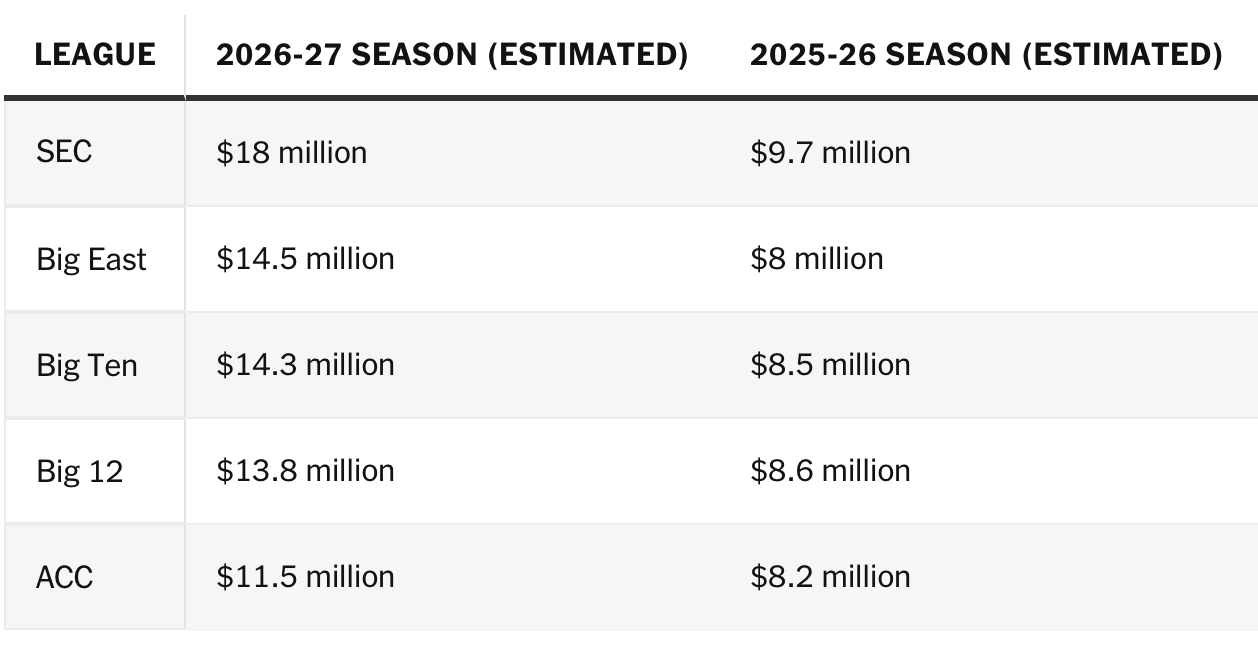
With the caveat that 25 coaches represent a modest sample size, and without access to Evan Miyakawa’s stakeholder-facing database of NIL valuations (which would seem to broadly support the numbers CJ and Brendan got back), this was fascinating. A lot stuck out. The sheer speed of growth, first of all. Everyone is spending more. A lot more. The SEC was already out front last summer, and appears to have gone completely insane since. A one-year doubling of roster spending? An average cost of $18 million per roster, in a league where so much of total NIL investment is inherently hoovered up by football? Is the money just unlimited?
(The recent rhetoric at football media days about the quality of the SEC’s primary sports product, and whether it has been surpassed in investment and results by the Big Ten — and Curt Cignetti’s response to SEC complaints Thursday, which were very funny — makes all this doubly interesting. SEC: basketball league?!)
The ACC’s relative financial stagnation is also intriguing and believable. It matches the overall vibe of the modern ACC, or at least many of its members, where aggressive athletic investment often feels begrudging. It is also a bigger conference with vastly diverging types of basketball programs and fan bases, ranging from utterly obsessed bluebloods to, well, this. Some of those schools are going to drag down your average. Anyway, the key word here is “relative.” A 40 percent year-over-year increase is still a lot! If you’d predicted that a year ago, we would have said the league was really about to amp things up. And it is! It’s just that everyone else is apparently doing more.
None of these were the biggest takeaway, though. The most glaring whoa-wait-WHAT?! in this list is obviously the Big East — where the league’s prophesied fiscal revolution has officially come to pass.
In the matter of one calendar year, the Big East has gone from spending the least of college hoops’ power five conferences to more than anyone but the ESS EEE SEE. This was the foretold effect of the House settlement and the introduction of revenue-sharing: Without football to worry about, Big East teams could distribute a much larger slice of their guaranteed $21 million-ish revenue pie to basketball. They can also, as coaches noted to The Athletic, offer the certainty of directly funded deals with players that don’t risk getting blown up by the NIL Go clearinghouse, which has rejected $90 million worth of NIL contracts in the last 12 months.
None of this is new — it played at least some role in Kevin Willard figuring Villanova was a better job than once-and-future sleeping giant Maryland in March 2025 — but it is nonetheless stunning to see it swiftly play out.
Lest this still sound farfetched to you, none other than St. John’s coach Rick Pitino helpfully backed up The Athletic’s estimations. On Wednesday, Pitino told NJ.com that “Marquette, Providence, Xavier, Connecticut, St. John’s and probably Georgetown have all spent probably more” than $14.5 million on their rosters.


Pitino’s predictions — that he’d pick Marquette, which never got close to making the 2026 tournament, to win the league, and that Xavier, Providence, and Villanova would all compete for the league title — are classic offseason Pitino, in that the guy is always delivering one hot take or another this time of year. Yet they also ring as broadly true, or at least speak to the overall lift in quality you see the more you dig in to this league.
(You know, except Georgetown. More on which below.)
The revelation of the Big East’s deep pockets happened, for me, just after this week’s podcast conversation with Matthew Winick, whose annually incredible offseason transfer portal rankings sheet was noticeably positive about a bunch of these programs, and really the league as a whole.
Scrolling down Winick’s rankings — before you even dive into his analysis of individual players and grades and overall team fit — left one with the impression that pretty much every Big East team needed to level up this spring did so. You can just go right down the list:
