

This is Better Know a Conference, Buzzer’s annual preview series. Before Nov. 2, we’ve been writing the detailed stories — a mix of roster breakdowns and overarching narratives — of the 2026-27 season to come.
This year, we’re also running our first ever subscriber sale, where you can get 25% off an annual subscription by clicking here or at the button just below this paragraph. The deal expires Monday! It’s the perfect chance to join the welcoming Buzzer community and get access to everything we write, all year round. One of us! One of us!
Today: A systemic look at the teams and leagues outside the five power conferences, plus everything else that’s worth saying before the season (finally) tips off Sunday morning in Rome. If you want to hear extended, highly detailed breakdowns of dozens of non-high-major teams, we direct you to our recent Basket Under Review mid-major preview with Will Warren.
Will wrote deep previews of a bunch of these leagues, and is also a sicko par excellence, so instead of regurgitating all of our detailed opinions in written form below, this newsletter is going to zoom out and cover less well-trod ground. But please go listen to the pod! Subscribe, tell a friend, all that. The show is humming along and has been lots of fun, and there’s much more to come.
One more thing: It’s time to fire up the Buzzer chat! As is tradition, we’ll be live-yapping with subscribers throughout Sunday’s season opener in Rome, and all along next week, and pretty much non-stop throughout the season. Join us!

And now back to your regularly scheduled preview newsletter. Bring on the ball.
The Basketball Quant, whose coaching data we referenced in the Michigan portion of this week’s Big Ten preview (in short: Dusty May was freaking amazing), produced a fascinating graphic Thursday:
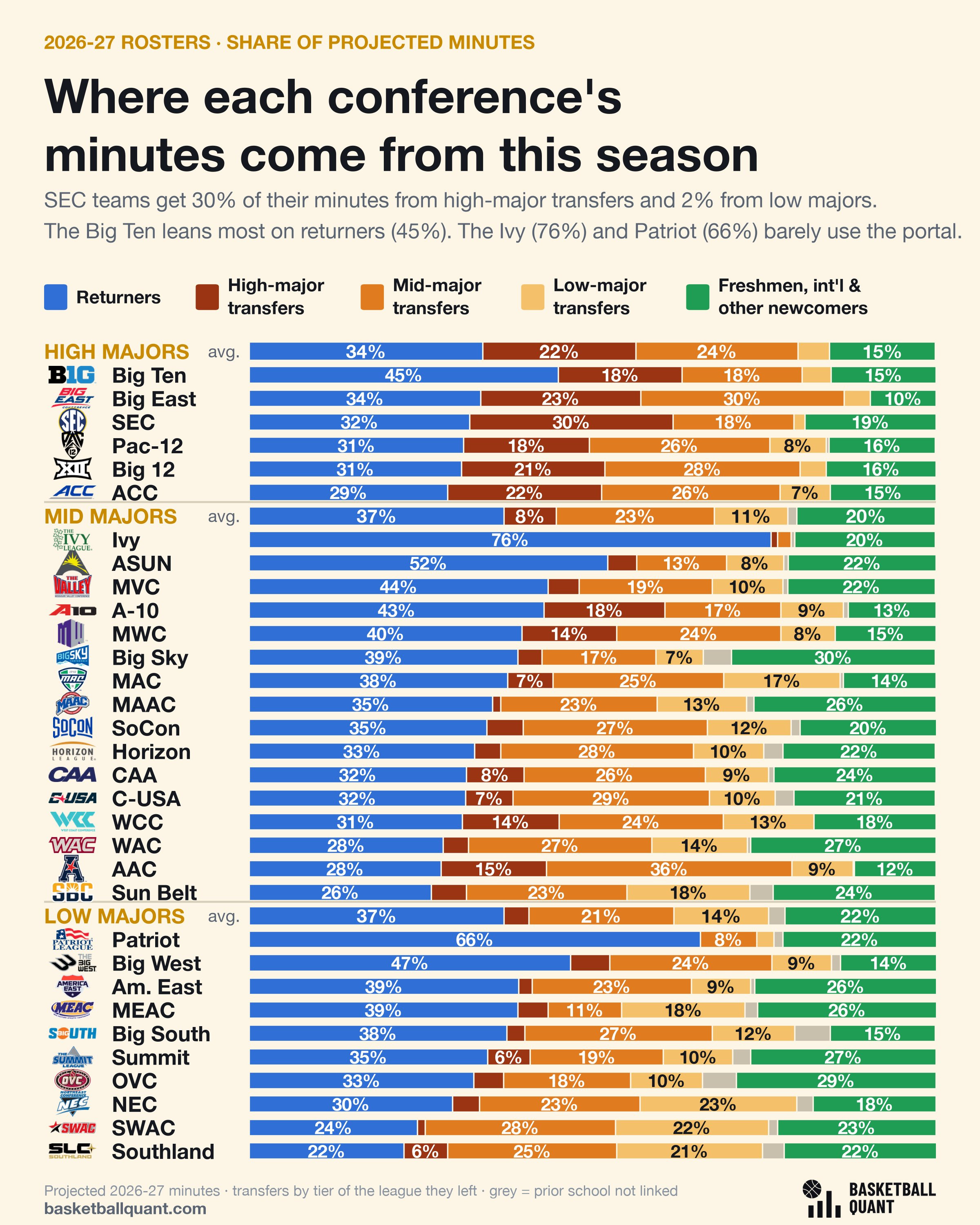
Excellent chart. Also: strangely satisfying. The conclusions about where the major leagues are sourcing their talent vaguely align with the perceptions we’ve formed as we’ve dug deep into every power conference squad these past few weeks — the trends you pick up on but can’t really articulate when you spend way too much time staring at roster spreadsheets. The SEC spent the most money, and thus had first pick of the high-major guys on the market. Culturally, big swathes of the Big Ten are more comfortable with retention. The Big 12 and Big East run the gamut. This all tracks.
Mid-major transfers are everywhere, but — at least anecdotally — we’d guess they tend to be clustered among teams in the back half of these leagues. We’ve tried not to automatically dismiss rosters with huge mid-major influxes, but it’s nobody’s ideal build. Those programs want meaningful Division I experience but can’t splash out for a bunch of proven, elite guys — which, given the budgets and prestige of a big chunk of the ACC, probably explains why that league’s numbers look the way they do.
Most of all, though, you see college basketball’s new ruthless pyramid in action.
Relatively few low-major players make a straight leap to the top leagues. More often they filter through, replacing the mid-major guys who vacated spots on their own march up the ladder. You can practically hear the giant sucking sound emanating from the very top, the raw gravitational pull. The big fish eat the little ones, all the way down.
This process, so accelerated in the NIL/portal era, has been great for the top of the game. Rick Pitino, noted ball-knower, said the other day what we’ve been saying for years: The basketball is better than ever. It keeps getting better. For the vast majority of fans — who tend to be fans of popular high-major schools, or casuals who just flip on the ranked matchups any given weeknight — this migration is good.
It is, very obviously, not good for mid-majors.
The occasional chance to rehabilitate a pedigreed prospect who didn’t stick at a top school is great and all, but that down-transfer alpha is vastly outstripped by the top schools’ punishing talent harvest. Most mid-major coaches have made peace with this problem by now. They understand what their job really entails; they still happily sign up for it anyway. But the effects on the broader balance of the sport feel glaring.
The other day, in preparation for yet another podcast (we’re doing two a week this season!) we threw the KenPom, Evan Miyakawa, and Bart Torvik preseason rankings into a spreadsheet. We used that composite to create a big S-curve that we could use to generate a big old 76-team-tournament preseason “bubble.” We did this mostly so we could jokingly annoy Tate by forcing him to a) talk about the bubble, which he hates doing even in February and b) make predictions, which he also does not like.
It was funny (to us, anyway). It was also, sadly, instructive.
Despite the expansion of the NCAA Tournament, almost every team on the list — and there were 43, we went through them very quickly — came from a power conference. The ones that didn’t were barely mid-majors by any classic definition.
You don’t even have to complicate it with a spreadsheet; you can just glance at your preferred preseason ranking system. At KenPom (save Gonzaga, which doesn’t count) Grand Canyon is the only non-power league team in the preseason top 50. Grand Canyon spent a ton of money on its roster. Grand Canyon only recently became a not-for-profit school. It also kind of doesn’t count.
From there, it’s all new Pac-12/former Mountain West schools (Utah State, Boise State, Colorado State, San Diego State), the moneyed A10 favorites (SLU, VCU, Dayton), current Mountain West holdovers (Nevada, New Mexico, UNLV, which presumably has a lot to do with A.J. Storr, which, LOL) and, all the way down in the 80s and 90s, the first appearance from anyone in the American, the league that was formed to assert the superiority of football over the classic Big East (Memphis, Wichita State, South Florida). Hell, even Saint Mary’s, stripped of the certainty of Randy Bennett, is 75th. UC San Diego is 91st. Murray State is 97th. That is as high as the true mid-majors get.
(But Eamonn, you say, what about High Point?! High Point checks in at 61st. True. But High Point is, well, High Point. High Point spends more money than the rest of its league combined. High Point’s preseason conference over/under is 15.5 — and Big South teams play 16 league games.)
It wasn’t always this way. In 2015, Wichita State, then of the Missouri Valley Conference, was ranked 10th in KenPom’s preseason rankings. In 2016, they were 16th. In 2012, New Mexico started the season 26th. Belmont entered that same season 27th. Xavier was ranked 15th. Harvard began the 2014 season 51st. They started the next season ranked 29th, and tied for 25th in the Associated Press preseason poll. Harvard! The Harvard Crimson! The basketball team!
If you want to look at the AP preseason poll, by the way, Rhode Island was ranked 23rd in 2017. Temple was 22nd in 2011. Memphis was in the C-USA during the whole John Calipari period, and of course they pop up in these polls a lot, however much of a mid-major label you want to assign to a program that had Calipari and Derrick Rose. Southern Illinois was ranked in 2008. Nevada, then in the WAC, was 22nd in 2006 — one spot behind George Washington. Western Kentucky in 2003. You get the point.
Is this cherrypicking? A bit, sure. Still, there are others out there, and the preseason KenPom histories only go back to 2012. And, yes, some of this has to do with conference consolidation, which has backfilled with the best mid-major programs for years. The point is it used to be much more common to scan these rankings in October and see a smattering of top-30-ish teams from outside the very biggest leagues, and not just in the A10 or the Mountain West but in leagues like the Valley or the Ivy League or the OVC, and then know them, and feel smart about them, and now you don’t get anything close.
This has major implications for the newly expanded NCAA Tournament. We are just in the preseason, with zero (non-exhibition) basketball played, and lots has to happen. Who knows, right? But you’re here now, and if you’re looking ahead, basing your expectations solely on roster talent — however you want to quantify it, whatever you think about individual players or coaches — the only reasonable expectation is that the new tournament will mostly expand in the direction of high-major programs. Plenty of preseason brackets project the same number of multi-bid conferences as last year. Those new spots will be filled by, well, you can guess. The NCAA remains admirably committed to admitting the best teams regardless of size or conference affiliation — really, they do — it’s just that the sport itself is trending in this way already.
We wrote about this phenomenon last fall …

… and, it turns out, we were right. At the time. Then time progressed. Now it’s now. Until next year, when that will be the worst time, until the year after that. The big fish will get bigger and the small ones will get smaller, and on and on forever, amen.
And now for the good news: The Pac-12 is (sort of) back
Three years ago, right around the time Buzzer launched, the Pac-12 died. (Having just written this sentence, we immediately realized its similarity to the classic Dave Chappelle-Pope Benedict tweet, all of which we are just going to keep in.) Even now, we’re still not totally sure people have gotten their heads around how crazy this was. The Pac-12 was a pillar of college athletics. The core of its membership joined the league in the 1910s and 1920s. It was culturally coherent, rife with unique rivalries and customs, and because its leadership failed to negotiate a lucrative-enough-by-a-few-million-dollars television deal, its schools were carved up and doled out by the victors like colonial provinces after the Seven Years’ War. Grim.
That Pac-12 is gone forever. But a Pac-12 is back. It is a shuffling reanimated corpse, sure, but it’s a thing called the Pac-12 and it has Gonzaga playing basketball in it, and the closer we get to seeing it the more we’re talking ourselves into the idea.